Mutual Funds vs ETFs: If you’ve ever wondered whether you should invest in mutual funds or ETFs, you’re not alone. It’s one of the most common questions every beginner investor faces — and even experienced investors revisit it as markets evolve. Both options offer incredible opportunities for wealth growth, but they work differently. Understanding those differences can make a huge impact on how your portfolio performs over time.
In this article, I’ll break it down step by step — no jargon, no confusing charts — just clear explanations and practical advice you can apply whether you’re investing from the USA, Canada, or the UK.
Mutual Funds vs ETFs: Understanding the Basics, Mutual Funds and ETFs
Before diving into which is better, let’s make sure we’re on the same page about what each one is.
A mutual fund is like a basket of investments managed by professionals. When you invest in a mutual fund, your money is pooled together with other investors to buy a wide range of assets — usually stocks, bonds, or a mix of both. The goal is to generate returns based on the fund’s strategy, and the fund manager decides which securities to buy or sell.
An ETF, or Exchange-Traded Fund, works in a similar way. It also represents a basket of securities, but the key difference is how it’s traded. ETFs are listed on stock exchanges, so you can buy or sell them throughout the day just like individual stocks.
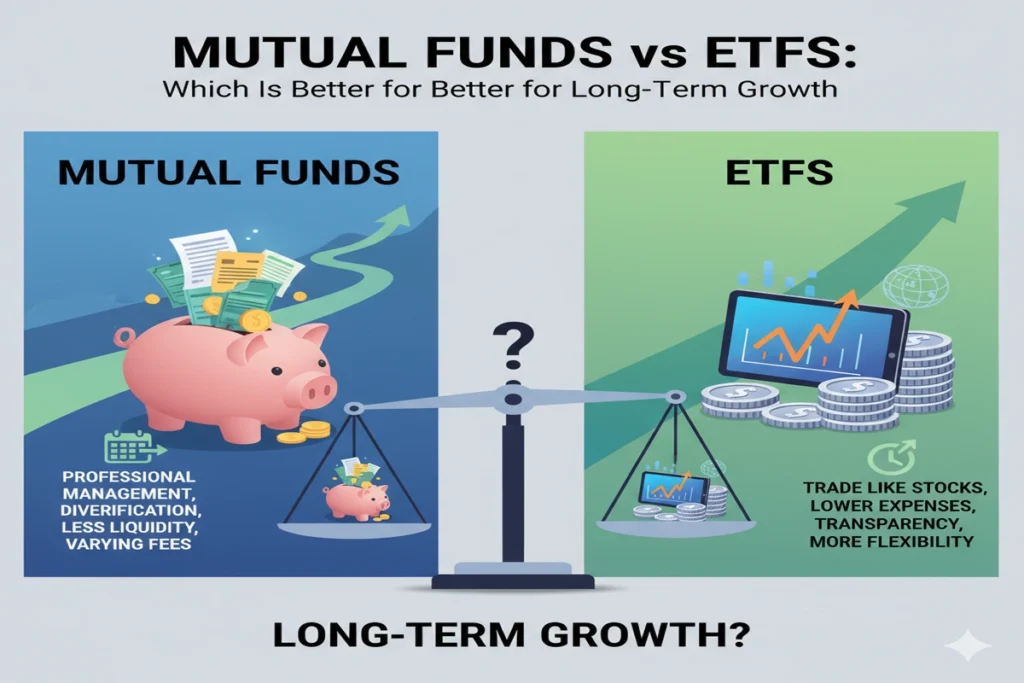
In short, mutual funds are managed by professionals and priced once a day, while ETFs are traded by investors directly on the market, with prices changing constantly during trading hours.
The Main Difference: How They’re Managed and Traded
Mutual funds can be either actively or passively managed. Actively managed funds rely on fund managers who try to outperform the market by selecting the best investments. Passive funds, on the other hand, simply track a market index like the S&P 500.
Most ETFs are passively managed — they mirror an index and have lower management costs. However, actively managed ETFs are becoming increasingly popular as technology allows real-time trading with professional oversight.
Trading is another major difference. Mutual fund transactions occur only once a day after the market closes, based on the fund’s Net Asset Value (NAV). ETFs, however, can be traded at any time during the day, allowing investors to respond to market changes instantly. This flexibility can be valuable for experienced investors but unnecessary for long-term ones who prefer a set-and-forget strategy.
Fees and Costs: Why ETFs Usually Win Here
Let’s be honest — fees can quietly eat away at your returns over time. Mutual funds often come with higher expense ratios because of active management and operational costs. These include management fees, marketing fees, and even sales commissions.
ETFs, on the other hand, usually have lower fees since they are passively managed. You’ll only pay a small annual expense ratio and perhaps a minor trading fee when buying or selling.
For example, a mutual fund might charge an annual fee of 1.2%, while a comparable ETF might charge just 0.05%. Over a decade, that difference could add up to thousands of dollars — money that could have stayed in your portfolio, compounding quietly.
If your goal is long-term growth, minimizing costs gives you a clear edge.
Accessibility and Flexibility: ETFs Are More Liquid
Liquidity refers to how quickly you can buy or sell an investment without affecting its price. ETFs excel here because they trade on exchanges in real time. You can buy shares in the morning and sell them in the afternoon if you choose to.
Mutual funds, by contrast, execute trades only at the end of the day. So, if you sell in the morning, you’ll have to wait until the market closes to know your exact sale price.
For investors in the USA, Canada, and the UK who want more control and flexibility, ETFs often feel more modern and convenient. But if you prefer a slower, long-term approach and don’t care about daily price movement, mutual funds still serve their purpose well.
Tax Efficiency: ETFs Take the Lead
Taxes are a crucial but often overlooked part of investing. Mutual funds typically distribute capital gains to all investors when the fund manager sells underlying assets at a profit. That means even if you didn’t sell your mutual fund, you might still owe taxes.
ETFs are structured differently. Their creation and redemption process happens “in-kind,” meaning that investors exchange shares for the underlying assets without triggering taxable events. As a result, ETFs are generally more tax-efficient than mutual funds — especially in countries like the USA and Canada where capital gains taxes can bite hard.
If you’re aiming for long-term growth and want to minimize taxes, ETFs often make more sense from a structural standpoint.
Performance Over Time: Depends on the Strategy
When it comes to returns, the debate gets interesting. Actively managed mutual funds sometimes outperform the market in short periods, particularly during volatile years when skilled fund managers can make strategic moves.
However, over long horizons — 10, 20, or even 30 years — studies have shown that low-cost index ETFs tend to outperform most actively managed mutual funds after accounting for fees and taxes.
That’s not to say mutual funds are bad investments. Many high-quality funds have beaten their benchmarks consistently. But for most everyday investors who just want stable, long-term growth, broad-market ETFs like the S&P 500 or MSCI World Index ETFs often deliver strong, predictable results.
Minimum Investment Requirements
One of the barriers to investing used to be high minimum investment amounts. Many mutual funds still require minimum investments ranging from $1,000 to $3,000.
ETFs, by contrast, can be purchased one share at a time — or even as fractional shares through platforms like Fidelity, Vanguard, or Wealthsimple in Canada. This makes ETFs more accessible for new investors who want to start small and scale gradually.
So, if you’re just getting started with $100 or $500, ETFs are typically the easier way to begin your journey toward long-term growth.
Automation and Simplicity: Mutual Funds Offer Ease
Here’s where mutual funds regain some ground. If you prefer complete automation — setting up automatic monthly contributions, reinvestments, and portfolio rebalancing — mutual funds make it seamless.
You can invest a fixed amount each month, and your mutual fund handles everything behind the scenes. ETFs can also be automated, but it usually requires setting up auto-invest through your brokerage account, which may not be as smooth depending on the platform.
So, for investors who value simplicity and a hands-off approach, mutual funds are still attractive options.
Transparency and Real-Time Tracking
ETFs are highly transparent. Most publish their holdings daily, allowing investors to see exactly what they own. Mutual funds, on the other hand, typically disclose holdings only quarterly, meaning you may not always know your exposure in real time.
Transparency builds trust — and in an age of digital investing, more investors prefer ETFs precisely because they can see what’s inside the fund at any moment.
Risk and Diversification: Both Can Be Balanced
Both ETFs and mutual funds offer diversification, which reduces your risk by spreading investments across many assets. However, the degree of diversification depends on what type of ETF or mutual fund you choose.
Broad-market ETFs like Vanguard Total Stock Market ETF (VTI) or iShares Core MSCI World ETF cover thousands of companies worldwide, offering a strong safety net against volatility. Similarly, balanced mutual funds that invest in both stocks and bonds provide risk-adjusted growth.
In essence, both can be equally safe if chosen wisely — the difference lies in your personal control and cost preferences.
Technology and AI in Modern Investing
The future of investing is changing fast, especially with AI-powered tools entering the scene. Robo-advisors like Betterment, Wealthsimple, and Nutmeg use algorithms to build portfolios primarily composed of ETFs.
This shift shows a global trend — automation and technology prefer ETFs due to their cost efficiency, transparency, and ease of trading. Mutual funds are adapting, but ETFs fit naturally into these new platforms.
For investors in 2026 and beyond, AI-driven investing tools are likely to favor ETFs even more.
Long-Term Wealth Growth: The Real Goal
Building long-term wealth isn’t about chasing the highest returns every year — it’s about consistency. If you invest regularly, reinvest your dividends, and minimize fees, your money will compound over time.
Let’s say you invest $500 per month in an ETF with an average annual return of 8%. After 20 years, your portfolio would grow to more than $295,000. The power of compounding doesn’t rely on timing the market; it relies on time in the market.
Whether you choose ETFs or mutual funds, discipline matters more than short-term performance.
Which Is Better for You?
If you want lower fees, real-time flexibility, and better tax efficiency, ETFs are hard to beat. They suit investors who enjoy being hands-on or who use digital platforms for managing their portfolios.
If you prefer convenience, automatic investing, and professional management, mutual funds still shine. They’re great for retirement accounts or for investors who want to focus on long-term goals without daily involvement.
Ultimately, there’s no absolute winner — it’s about which aligns best with your personality, investing habits, and goals.
Final Thoughts
The debate between mutual funds and ETFs will continue, but one thing remains clear: both can help you achieve long-term growth if used correctly. The secret isn’t choosing the perfect product; it’s choosing the right mindset.
Start early, stay consistent, and focus on compounding rather than quick gains. The stock market rewards patience more than prediction.
Whether you’re in New York, Toronto, or London, the path to long-term wealth is the same — steady, smart, and simple investing.
FAQs
1. Are ETFs safer than mutual funds?
ETFs and mutual funds carry similar risks because both depend on market performance. However, ETFs are often more transparent and tax-efficient, which adds to their appeal.
2. Which performs better in the long run?
Low-cost index ETFs generally outperform actively managed mutual funds over long periods due to lower fees and higher tax efficiency.
3. Can I invest in both ETFs and mutual funds?
Absolutely. Many investors use both — ETFs for passive index exposure and mutual funds for active or sector-specific strategies.
4. Are mutual funds outdated?
Not at all. Mutual funds remain a powerful tool for retirement plans and investors who prefer automated management.
5. What’s the best choice for beginners in 2026?
For new investors, ETFs often make sense because they’re affordable, transparent, and easy to access through modern apps and robo-advisors.
Leave a Reply