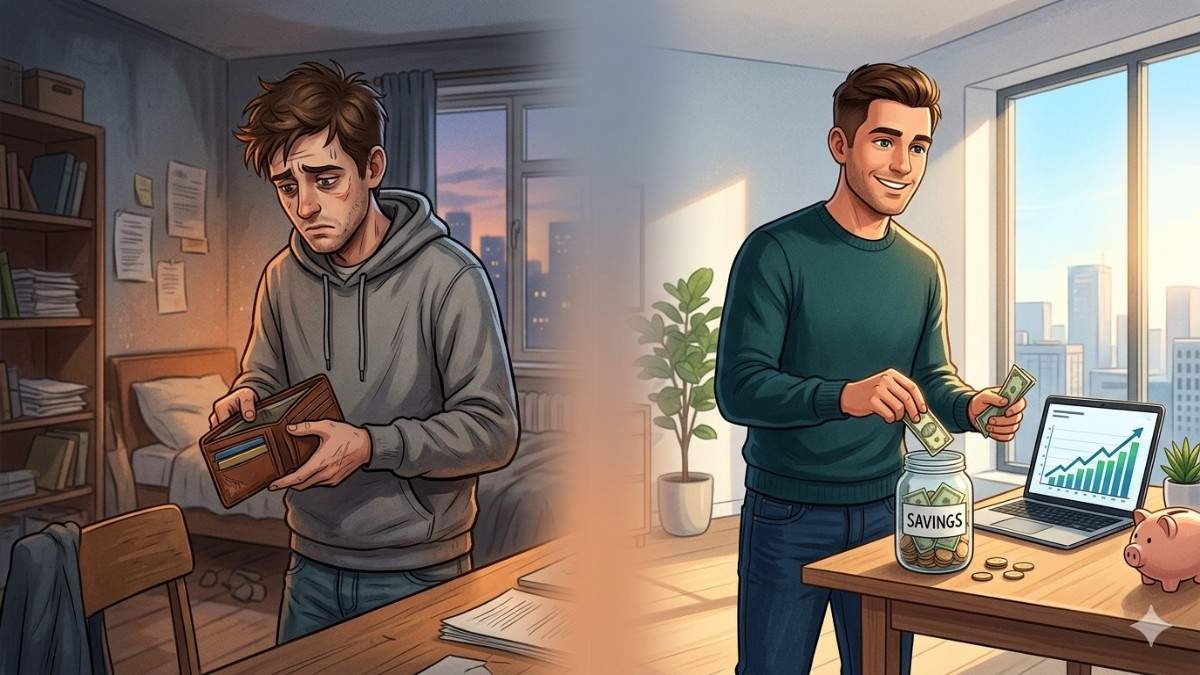
The Problem Nobody Talks About Honestly
Let’s be real for a moment.
Living paycheck to paycheck is not just a financial situation — it’s a mental burden.
It’s waking up in the morning and checking your bank balance before even brushing your teeth.
It’s calculating in your head whether you can afford something as small as a meal or a ride.
It’s feeling a small sense of relief on payday… and then watching that relief disappear within a few days.
You work hard. You’re not lazy. You’re not irresponsible.
And yet… you feel stuck.
This is where most people get it wrong.
They think:
“I just need to earn more money.”
But here’s the uncomfortable truth:
👉 There are people earning $1,500/month stuck in this cycle
👉 And there are people earning $5,000/month stuck in the SAME cycle
So the problem is not just income.
The real problem is this:
👉 You don’t have a money system — you have a money flow problem
Money is coming in.
But it’s leaking out… fast.
And because there’s no structure, no control, and no plan — every month starts from zero again.
This article is not going to give you generic advice like:
- “Just budget better”
- “Stop buying coffee”
- “Save more money”
You’ve heard all that before.
Instead, I’m going to show you:
- Why you’re actually stuck (real reasons, not theory)
- What is happening to your money behind the scenes
- And how to break this cycle step by step
By the end of this guide, you will not just “understand” your problem.
👉 You will know exactly what to do next.
What Living Paycheck to Paycheck REALLY Looks Like (Real Life Scenario)
Let’s take a real example.
Imagine you earn $2,000 per month.
Sounds decent, right?
Now let’s break it down:
- Rent: $900
- Groceries: $300
- Transport: $200
- Utilities + phone + internet: $150
- Debt payments: $200
- Small daily expenses (coffee, snacks, random): $150
Total = $1,900
What’s left?
👉 $100
Now from that $100:
- Maybe you go out once
- Maybe you buy something you delayed earlier
- Maybe something unexpected happens
And suddenly…
👉 You’re back to $0
Now imagine this:
Your car needs repair → $250
Your family needs help → $150
Medical expense → $100
You don’t have savings.
So what do you do?
👉 Credit card
👉 Borrow money
👉 Delay payment
Now next month is even worse.
Quick Answer: How to Stop Living Paycheck to Paycheck
To stop living paycheck to paycheck, track your expenses, create a simple budget, cut unnecessary spending, build an emergency fund, and increase your income through side hustles or better opportunities.
This is the real paycheck-to-paycheck trap:
It’s not just that you’re broke.
👉 It’s that you are always one problem away from stress
Why You’re Stuck (The Truth Most Articles Don’t Tell You)
Let’s go deeper.
Because surface advice won’t fix a deep problem.
1. You Don’t Have a System — You Have Reactions
Most people don’t manage money.
They react to it.
Salary comes → bills come → spending happens → stress comes
There is no structure.
No plan.
No control.
Just reaction.
2. Your Money Is Leaking in Small Ways
Here’s something most people ignore:
👉 Big expenses are obvious
👉 Small expenses are dangerous
Let’s break it down:
- Coffee: $5 × 25 days = $125
- Food delivery: $15 × 8 times = $120
- Subscriptions: $60
- Random purchases: $100
That’s $400+ gone
Every month.
That’s nearly:
👉 $5,000 per year
And most people don’t even realize it.
3. Lifestyle Inflation Is Quietly Destroying You
This is one of the biggest traps.
You get a salary increase.
Instead of improving your life…
👉 You upgrade your lifestyle
- Better phone
- Better house
- More spending
- More comfort
And guess what?
👉 You are STILL broke
Because your expenses grew faster than your discipline.
4. You’re Trying to “Feel Better” With Money
This is the most dangerous one.
You’re not spending for need.
👉 You’re spending for emotion
- Stress → order food
- Sad → shop online
- Happy → celebrate with spending
Money becomes your emotional tool.
And that’s when control disappears.
5. You Think the Problem Is Income (But It’s Not)
Yes, income matters.
But here’s the truth:
👉 If you cannot manage $2,000
👉 You will struggle with $5,000 too
Because habits don’t change automatically.
The Psychology Behind Your Spending (This Will Change Everything)
Let me tell you something powerful:
👉 You don’t have a money problem
👉 You have a behavior pattern
And until that changes…
Nothing else will.
Emotional Spending (The Silent Killer)
You don’t realize it, but many of your spending decisions are emotional.
Think about it:
- Bad day at work → “I deserve this meal”
- Feeling low → “Let me buy something small”
- Weekend → “Let’s enjoy a little”
None of these feel wrong.
But they add up.
Identity Spending (Very Important)
This one is deep.
You spend money to feel like someone.
- Successful
- Rich
- Stylish
- Socially accepted
So you buy things that match that identity.
Even if you can’t afford them.
Social Media Pressure (Modern Problem)
You see:
- Friends traveling
- People buying cars
- Influencers living “perfect” lives
And you start thinking:
👉 “I should also live like this”
So you spend.
Not because you need to.
But because you don’t want to feel left behind.
The Most Important Mindset Shift
Right now, you think:
👉 “How can I save money?”
Wrong question.
Start thinking:
👉 “How can I control where my money goes?”
That one shift will change your financial life.
What I Would Do If I Had $0 Savings Today
Let’s make this practical.
If I were in your position right now, starting from zero…
This is exactly what I would do.
Step 1: Stop the Bleeding
Before saving…
👉 Stop unnecessary spending
Not everything.
Just obvious leaks.
Step 2: Track Every Dollar
For 30 days:
👉 Write EVERYTHING
No guessing.
No assumptions.
Step 3: Create a Survival Budget
Only essentials:
- Rent
- Food
- Transport
- Bills
Everything else → optional
Step 4: Start Small Savings (Very Important)
Even if it’s:
👉 $2 per day
👉 $5 per day
Start.
Because momentum matters more than amount.
Step 5: Find One Extra Income Source
Not 5.
Just 1.
- Freelance
- Part-time
- Online work
Even $100 extra changes everything.
Reality Check (Important Before Moving Ahead)
Let me be honest with you:
👉 This is not easy
👉 This is not quick
👉 This is not overnight
But it is simple.
And it works.
How to Stop Living Paycheck to Paycheck (2026 Real-Life Guide)
The System That Actually Gets You Out
The Biggest Shift You Must Make First
Before we go into steps, you need to understand this:
👉 You don’t fix money problems with motivation
👉 You fix them with systems
Motivation fades.
Systems repeat.
Right now, your system is:
Earn → Spend → Stress → Repeat
We are going to replace it with:
Earn → Control → Save → Grow → Repeat
Step 1: Build Your “Money Control System”
This is your foundation.
Without this, nothing else works.
The 4-Account Method (Simple but Powerful)
Create 4 separate sections (accounts or mental buckets):
- Bills Account
Rent, utilities, fixed expenses - Living Account
Food, transport, daily spending - Savings Account
Emergency fund (do NOT touch) - Growth Account
Investing / future money
Why This Works
Right now your problem is:
👉 All money is in one place → no control
This system creates:
👉 Clarity + boundaries
Example
Let’s say you earn $2,000
You divide like this:
- Bills: $900
- Living: $600
- Savings: $300
- Growth: $200
Now your spending becomes controlled automatically.
Step 2: The “Pay Yourself First” Rule
Most people do this:
Spend first → save what’s left
Wrong.
You must do:
Save first → spend what’s left
Practical Example
Salary comes: $2,000
Immediately:
- $300 → Savings
- $200 → Growth
Now you live on $1,500
👉 This forces discipline without thinking.
Step 3: The Weekly Money System (Game Changer)
Monthly budgeting fails because:
👉 You overspend early
👉 Then suffer later
Weekly Breakdown
Instead of $600/month for living:
👉 Divide into weeks = $150/week
Your New Rule
👉 When weekly budget finishes → stop spending
No guilt.
No confusion.
Just control.
Weekly Routine
- Monday: Check balance
- Wednesday: Track spending
- Friday: Adjust
- Sunday: Review
👉 This alone can change your life.
Step 4: Cut Expenses WITHOUT Feeling Miserable
Most people fail here.
They try to cut everything.
They quit in 7 days.
Smart Way to Cut
Instead of:
❌ “No eating out ever”
Do this:
✅ “Eat out once a week instead of 4 times”
Replace, Don’t Remove
- Expensive coffee → cheaper option
- Daily delivery → home meals
- Impulse shopping → planned buying
👉 You don’t need sacrifice
👉 You need adjustment
Step 5: The Emergency Fund (Your First Real Goal)
This is non-negotiable.
Why?
Because without it:
👉 Every problem = financial crisis
Build Like This
- Start: $100
- Then: $500
- Then: $1,000
- Then: 3–6 months expenses
Real Example
If your monthly expense = $1,500
👉 Target = $4,500 – $9,000
Important Rule
👉 This is NOT spending money
👉 This is safety money
Step 6: Destroy Debt (Strategically)
Debt is what keeps you stuck.
Method 1: Snowball (Best for motivation)
- Pay smallest debt first
- Build confidence
Method 2: Avalanche (Best for saving money)
- Pay highest interest first
Example
Debt:
- $300
- $700
- $2,000
Start with $300 → finish → move forward
👉 Momentum matters more than math
Step 7: Increase Income (This Changes Everything)
Let’s be honest:
👉 You can only cut so much
👉 But you can earn unlimited
Simple Truth
If you increase income by $500/month:
👉 Your entire financial situation changes
Start Like This
Don’t overthink.
Pick ONE:
- Freelancing
- Online work
- Part-time job
- Skill-based service
Real Example
Let’s say:
Side income = $300/month
In 1 year = $3,600
That’s:
👉 Emergency fund
👉 Debt cleared
👉 Financial breathing space
Step 8: Build Multiple Income Streams
One income is dangerous.
Why?
If it stops:
👉 You are in trouble
Goal
- Main income
- 1 side income
- Later: passive income
Example
- Job: $2,000
- Freelance: $400
- Online income: $200
Total: $2,600
👉 Big difference
Step 9: Control Lifestyle Inflation
This is where most people fail.
Situation
You get a raise.
Instead of saving…
👉 You upgrade life
New Rule
👉 Income increases → Savings increase FIRST
Then lifestyle.
Step 10: Monthly Money Review (VERY IMPORTANT)
Most people never do this.
That’s why they stay stuck.
Every Month Ask:
- Where did my money go?
- What did I waste?
- How much did I save?
- What will I improve next month?
👉 This creates awareness + improvement
Real Example: Full Transformation Plan
Let’s combine everything.
Before
Income: $2,000
Savings: $0
Debt: $1,000
After Applying System (3–6 months)
- Savings: $1,500+
- Debt reduced
- Side income started
- Stress reduced
👉 Same income
👉 Different system
Reality Check (Important)
This system works.
But only if:
👉 You follow it consistently
Not perfectly.
Consistently.
How to Stop Living Paycheck to Paycheck (2026 Real-Life Guide)
Part 3: From Survival to Financial Freedom
Real-Life Transformation Story (This Is What It Looks Like in Reality)
Let me show you what this actually looks like in real life.
Not theory.
Not motivation.
Real change.
Meet David (Example You Will Relate To)
David earns $2,200/month.
His situation:
- Rent: $1,000
- Food: $300
- Transport: $200
- Bills: $200
- Other spending: $400
Total = $2,100
Savings = almost nothing
His Reality
- Always waiting for payday
- Using credit card occasionally
- No savings
- Stress during emergencies
What He Changed
Not his income.
👉 His system.
Month 1
- Started tracking expenses
- Reduced unnecessary spending
- Saved first $100
Month 2
- Created weekly budget
- Cut eating out by 50%
- Saved $300
Month 3
- Started freelance work
- Earned extra $200
Month 6
- Savings: $1,500
- Debt: almost gone
- Stress: reduced
Month 12
- Savings: $4,000+
- Side income: $400/month
- No financial panic
👉 Same person
👉 Same job
👉 Different system
Biggest Lies About Money That Keep People Broke
This part is important because many people are stuck due to wrong beliefs.
Lie 1: “I Need More Money First”
Truth:
👉 You need control first
If you can’t manage $2,000
You won’t manage $5,000
Lie 2: “Saving Small Amounts Is Useless”
Truth:
👉 Small savings build momentum
$5/day = $150/month
$1,800/year
That’s powerful.
Lie 3: “I’ll Start Next Month”
Truth:
👉 There is no perfect time
Start small. Start now.
Lie 4: “Budgeting Is Restrictive”
Truth:
👉 Budgeting gives freedom
Without it → chaos
With it → control
What Rich People Do Differently (That You Can Copy)
This is where the real difference is.
1. They Pay Themselves First
They don’t wait to save.
They save first.
2. They Track Money Regularly
Not once a month.
👉 Weekly.
3. They Control Lifestyle Growth
Income increases…
But lifestyle grows slowly.
4. They Focus on Income Growth
They don’t just cut expenses.
👉 They earn more.
5. They Think Long-Term
Not just today.
But 1 year, 5 years, 10 years ahead.
The Exact Monthly Escape Plan (Follow This)
If you want clear action, follow this.
Week 1
- Track all expenses
- No unnecessary spending
Week 2
- Create budget
- Cut 20% waste
Week 3
- Start saving
- Even $5/day
Week 4
- Review
- Adjust system
👉 Repeat every month
Advanced Strategy: How to Build Real Financial Freedom
Once you are stable…
Move to next level.
Step 1: Increase Savings Rate
From 10% → 20% → 30%
Step 2: Start Investing
- Index funds
- Stocks
- Long-term assets
Step 3: Build Passive Income
- Blogging
- YouTube
- Digital products
- Affiliate income
Step 4: Reduce Dependence on Salary
Goal:
👉 Income should not depend on one source
Common Mistakes That Will Put You Back to Zero
Avoid these.
1. Lifestyle Upgrade Too Early
Big mistake.
2. Ignoring Small Expenses
They matter.
3. Using Credit Casually
Dangerous habit.
4. Not Tracking Money
This is the biggest mistake.
5. Trying to Be Perfect
You don’t need perfection.
You need consistency.
The One Rule That Changes Everything
If you remember only one thing from this article, remember this:
👉 Control your money before your money controls you
Final Reality Check
Let’s be honest again.
This journey is:
- Not easy
- Not fast
- Not perfect
But it is:
- Simple
- Practical
- Life-changing
If you stay consistent:
👉 In 3 months → you feel control
👉 In 6 months → you see progress
👉 In 12 months → your life is different
Conclusion
You don’t need luck.
You don’t need a huge salary.
You don’t need to be perfect.
You need:
- Awareness
- A system
- Consistency
Start small.
Track your money today.
Make one better decision today.
Save even a small amount today.
Because your future will not change in one big step.
👉 It will change in small steps repeated daily.
Leave a Reply