Best Dividend ETFs for 2026: For many investors, the goal isn’t just growth—it’s consistent income. That’s where dividend ETFs come in. Instead of relying on a few individual dividend stocks, these funds spread your investment across dozens or even hundreds of income-producing companies.
As we move into 2026, dividend ETFs remain popular with investors who want:
- Regular cash flow
- Lower volatility than growth stocks
- Long-term portfolio stability
Whether you’re building a retirement portfolio or simply want passive income, dividend ETFs can play a key role in a balanced investment strategy.
Why Dividend ETFs Are Popular in 2026
Dividend investing has always been attractive during uncertain economic periods. When markets become volatile, income-producing assets often provide more stability.
Here’s why dividend ETFs are still a smart choice in 2026:
- Regular income: Many pay dividends quarterly.
- Lower volatility: Dividend stocks are often established, profitable companies.
- Compounding potential: Reinvested dividends can accelerate long-term growth.
- Diversification: One ETF can hold dozens of dividend-paying stocks.
For many long-term investors, dividend ETFs serve as the income engine of their portfolio.
Best Dividend ETFs for 2026
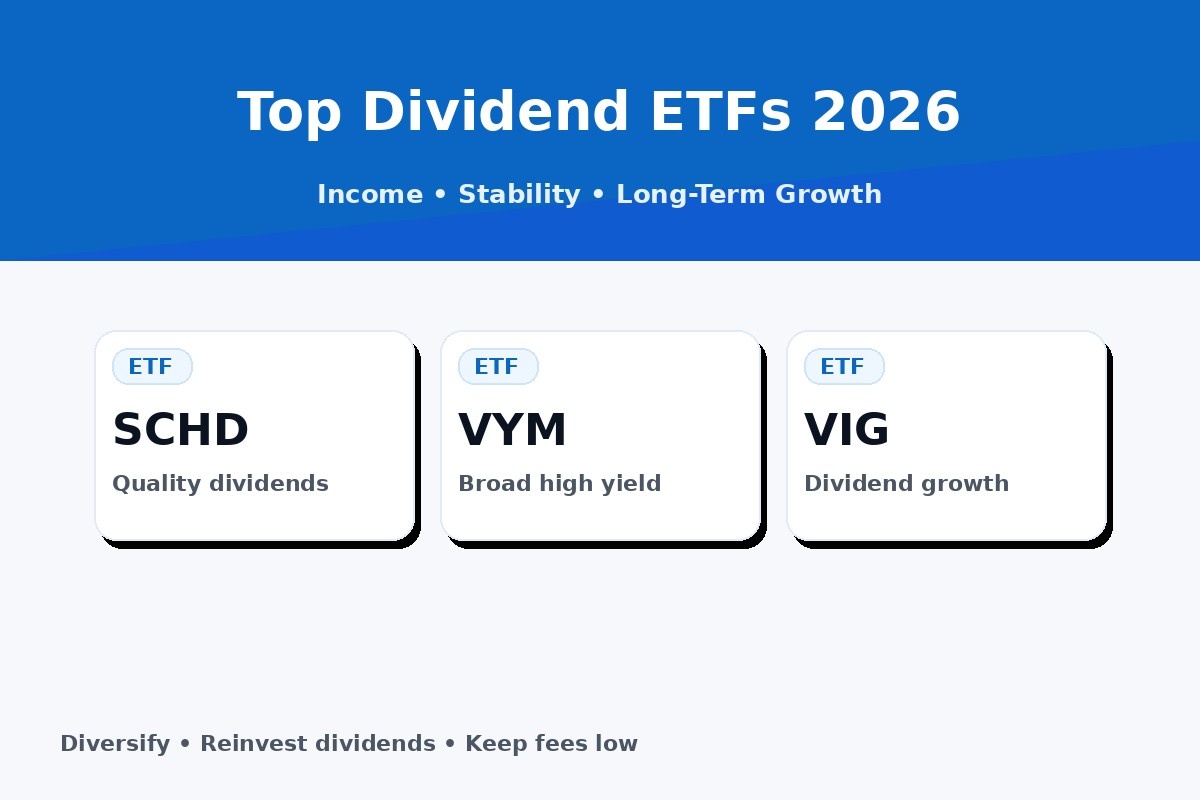
1. Schwab U.S. Dividend Equity ETF (SCHD)
Best for: High-quality dividend stocks
SCHD focuses on companies with strong fundamentals, stable earnings, and a consistent history of paying dividends. It’s one of the most popular dividend ETFs because of its balance between income and growth.
Why investors like SCHD:
- Low expense ratio
- Strong dividend yield
- Focus on financially stable companies
2. Vanguard High Dividend Yield ETF (VYM)
Best for: Broad dividend exposure
VYM tracks a large basket of high-dividend U.S. companies. It offers exposure to multiple sectors, making it a good core dividend ETF.
Key strengths:
- Broad diversification
- Reliable income stream
- Low management fees
3. iShares Select Dividend ETF (DVY)
Best for: Higher dividend yields
DVY focuses on companies with strong dividend payouts, particularly in sectors like utilities and industrials. It’s often chosen by investors seeking higher income potential.
Why consider DVY:
- Attractive yield
- Established dividend-paying companies
- Defensive sector exposure
4. Vanguard Dividend Appreciation ETF (VIG)
Best for: Dividend growth strategy
Unlike high-yield funds, VIG focuses on companies that consistently increase their dividends over time. These companies often have strong balance sheets and steady earnings growth.
Benefits of VIG:
- Focus on long-term dividend growth
- Lower volatility
- High-quality company selection
5. SPDR S&P Dividend ETF (SDY)
Best for: Dividend aristocrat exposure
SDY invests in companies that have increased their dividends for at least 20 consecutive years. These “dividend aristocrats” are known for their financial strength and reliability.
Why investors choose SDY:
- Strong dividend track record
- Blue-chip companies
- Long-term stability
Comparing the Best Dividend ETFs
| ETF | Strategy | Yield Focus | Best For |
|---|---|---|---|
| SCHD | Quality dividend stocks | Medium–high | Balanced income and growth |
| VYM | Broad high-dividend market | Medium | Core dividend holding |
| DVY | High-yield companies | High | Income-focused investors |
| VIG | Dividend growth companies | Low–medium | Long-term growth |
| SDY | Dividend aristocrats | Medium | Stability and consistency |
How Dividend ETFs Fit Into a Portfolio
Dividend ETFs are often used as the income portion of a diversified investment strategy.
A simple balanced ETF portfolio might look like this:
- 50% broad market ETF (VTI or VOO)
- 20% dividend ETF (SCHD or VYM)
- 20% international ETF
- 10% sector ETF (technology or healthcare)
If you’re building a long-term portfolio, you may want to start with a broad-market ETF. For a full breakdown, see our guide to the best ETFs to invest in 2026.
Dividend ETF vs Individual Dividend Stocks
Some investors wonder whether it’s better to buy dividend ETFs or individual stocks.
Dividend ETFs
Pros:
- Instant diversification
- Lower risk
- Less research required
Cons:
- Slightly lower yields compared to individual high-dividend stocks
Individual Dividend Stocks
Pros:
- Potentially higher yields
- More control over stock selection
Cons:
- Higher risk
- Requires more research
- Less diversification
For most beginners, dividend ETFs are the simpler and safer choice.
How to Choose the Right Dividend ETF
When selecting a dividend ETF, focus on these factors:
1. Dividend yield
Higher yields mean more income, but extremely high yields may carry more risk.
2. Expense ratio
Lower fees improve long-term returns.
3. Dividend history
Look for funds with consistent payouts over time.
4. Sector exposure
Some dividend ETFs are heavily concentrated in certain industries.
Key Takeaways
- Dividend ETFs provide regular income and stability.
- SCHD and VYM are popular core dividend funds.
- VIG focuses on dividend growth rather than high yield.
- Dividend ETFs work best as part of a diversified portfolio.
Frequently Asked Questions
What is the best dividend ETF for 2026?
SCHD and VYM are among the most popular dividend ETFs because they balance income, stability, and long-term growth.
Are dividend ETFs safe?
They are generally less volatile than growth ETFs, but they still carry market risk.
How often do dividend ETFs pay?
Most dividend ETFs pay quarterly, though some may pay monthly or semi-annually.
Final Thoughts
Dividend ETFs are a practical choice for investors who want a steady income stream without the complexity of managing individual stocks. They offer diversification, consistent payouts, and long-term stability.
In 2026, combining dividend ETFs with broad-market funds and a small allocation to growth sectors can help create a well-balanced portfolio that works in both strong and uncertain markets.
Related: Buy These 10 ETFs if You Want to be Rich in 2026
Vanguard vs BlackRock ETFs: Which Performs Better and Why Investors Are Talking About It
ETF vs Mutual Fund: Complete Guide for Investors in 2026
Investment Guide for GCC Professionals: How to Grow Your Money Smartly
Leave a Reply