
Learning How to Start Investing in Australia with $1,000 is one of the smartest financial decisions you can make in 2026. Many beginners believe investing requires large amounts of money, but that is no longer true. Today, you can start investing Australia with as little as $1,000 using beginner-friendly platforms and low-cost investment options.
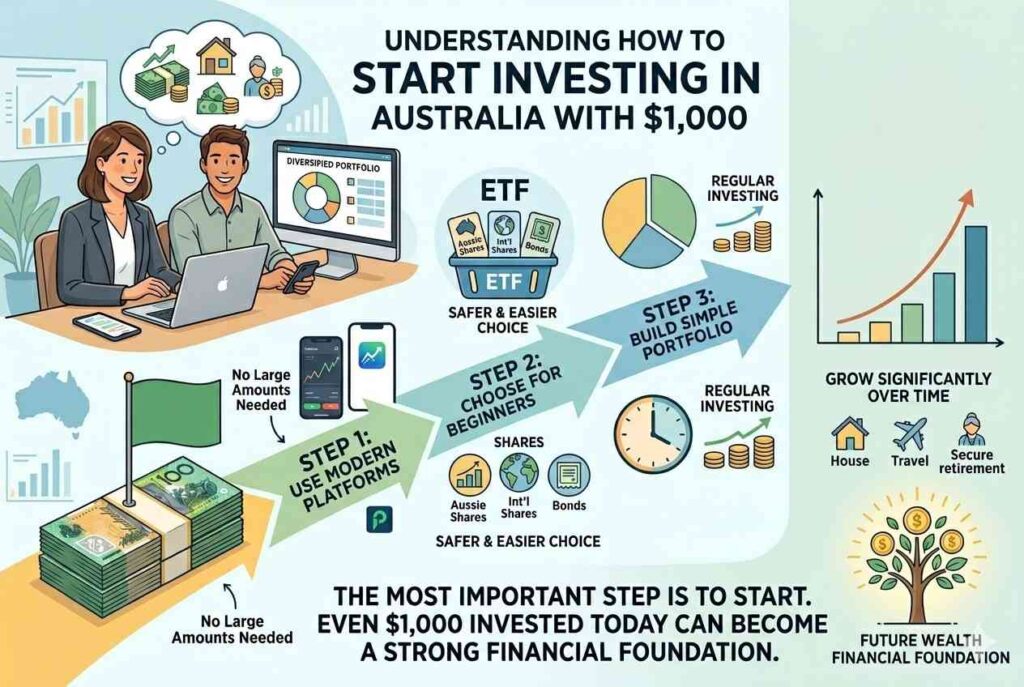
If you are new to beginner investing Australia, this guide will explain everything step by step. You will learn the safest investment options, best apps, and simple strategies to grow your money over time.
By the end of this article, you will know exactly how to invest your first $1,000 in Australia confidently.
Why This Topic Matters in 2026
Investing has changed dramatically in recent years. Technology has made it easier than ever for beginners to invest small amounts.
In 2026, inflation continues to reduce the value of savings. Money sitting in a bank account often grows slower than inflation.
This is why more Australians are searching for:
- start investing Australia
- beginner investing Australia
- small investment ideas
- ETF investing Australia
- best investment apps Australia
Starting early gives you a major advantage because of compound growth.
For example:
| Investment Amount | Annual Return | Value After 10 Years |
|---|---|---|
| $1,000 | 8% | $2,159 |
| $1,000 + $100/month | 8% | $19,500 |
Even small investments can grow significantly.
How to Start Investing in Australia with $1,000
If you want to know How to Start Investing in Australia with $1,000, follow these basic principles.
Step 1 — Set Financial Goals
Before investing, decide your goal.
Examples:
- Retirement savings
- Buying a house
- Emergency fund growth
- Passive income
Your goal determines your investment strategy.
Short-term goals need safer investments.
Long-term goals allow higher-risk investments.
Step 2 — Build an Emergency Fund
Never invest your last money.
Experts recommend saving 3–6 months of expenses before investing.
Keep emergency money in:
- High-interest savings accounts
- Offset accounts
- Cash management accounts
This protects you during unexpected situations.
Step 3 — Choose an Investment Platform
Australia has several beginner-friendly investment platforms.
Good platforms should offer:
- Low fees
- Easy interface
- Mobile app
- ETF access
- Fractional shares
Common beginner options include:
- Online broker apps
- Robo-advisors
- ETF platforms
Choose simple platforms when starting.
Best Investments to Start With $1,000
Here are the best options for beginner investing Australia.
1. Exchange-Traded Funds (ETFs)
ETFs are the easiest way to start investing Australia.
They allow you to invest in hundreds of companies with one purchase.
Benefits:
- Low risk compared to individual stocks
- Low fees
- Diversification
- Easy to manage
Popular ETF categories:
- Australian market ETFs
- Global ETFs
- Dividend ETFs
- Technology ETFs
A beginner can invest:
- $500 in Australian ETF
- $500 in global ETF
This creates a balanced portfolio.
2. Individual Stocks
Stocks offer higher growth potential.
However, they carry higher risk.
If you want to invest $1,000:
Example allocation:
- $400 ETF
- $300 blue-chip stock
- $300 growth stock
Blue-chip stocks are safer.
Growth stocks offer higher returns.
3. Robo-Advisors
Robo-advisors automatically invest your money.
They build portfolios based on your risk level.
Advantages:
- Automatic investing
- Diversified portfolios
- Beginner friendly
Disadvantages:
- Management fees
- Less control
Robo-advisors are ideal for beginners.
4. Micro-Investing Apps
Micro-investing apps allow small investments.
You can invest spare change.
Benefits:
- Easy to start
- Automatic saving
- Low minimum investment
Good for beginners who want discipline.
Best Allocation Strategy for $1,000
Here is a simple beginner portfolio.
| Investment | Amount | Risk Level |
|---|---|---|
| Australian ETF | $400 | Low |
| Global ETF | $400 | Low |
| Individual Stocks | $200 | Medium |
This is a balanced beginner portfolio.
Expert Tips for Beginner Investing Australia
Follow these tips to succeed.
Start Early
Time is more important than money.
Small investments grow over time.
Invest Regularly
Investing monthly is powerful.
Example:
- $100/month
- 10 years
- 8% return
Result:
$18,000+
Consistency wins.
Keep Fees Low
High fees reduce profit.
Choose low-cost investments.
ETFs are best for low fees.
Think Long Term
Avoid quick profits.
Successful investors think long term.
Invest for at least 5 years.
Reinvest Dividends
Dividends accelerate growth.
Always reinvest earnings.
Common Mistakes Beginners Make
Many new investors lose money because of mistakes.
Avoid these.
1. Waiting Too Long
Many people delay investing.
Starting earlier is better.
Even small investments matter.
2. Trying to Get Rich Quickly
Fast profits usually mean high risk.
Slow growth is safer.
3. Investing Without Research
Never invest blindly.
Understand your investment.
4. Panic Selling
Markets go up and down.
Selling during a crash locks losses.
Stay patient.
5. Lack of Diversification
Investing in one stock is risky.
Diversification reduces risk.
Pros and Cons of Investing $1,000
Advantages
- Easy to start
- Low risk entry
- Learning experience
- Long-term growth
- Financial discipline
Disadvantages
- Small initial returns
- Market risk
- Requires patience
- Brokerage fees
Real Examples of Investing $1,000
Here are real scenarios.
Example 1 — ETF Investor
Sarah invested $1,000 in ETFs.
Average return: 8%.
After 5 years:
Value:
$1,469
After 10 years:
$2,159
Example 2 — Monthly Investor
James started with $1,000.
Added $100/month.
After 10 years:
$19,500+
Example 3 — Stock Investor
Michael invested $1,000 in stocks.
Return: 12%.
After 10 years:
$3,100+
Higher risk but higher reward.
Step-by-Step Guide to Start Investing in Australia
Follow this exact process.
Step 1
Open a brokerage account.
Verification takes 1–2 days.
Step 2
Deposit $1,000.
Use bank transfer.
Step 3
Choose ETFs.
Start with diversified funds.
Step 4
Place your first order.
Buy ETF shares.
Step 5
Track your investments.
Check monthly only.
Avoid daily checking.
Comparison: ETFs vs Stocks vs Robo-Advisors
| Feature | ETFs | Stocks | Robo-Advisors |
|---|---|---|---|
| Risk | Medium | High | Low |
| Beginner Friendly | Yes | No | Yes |
| Diversification | High | Low | High |
| Control | Medium | High | Low |
| Fees | Low | Low | Medium |
ETFs are best for beginners.
Frequently Asked Questions
1. Is $1,000 enough to start investing in Australia?
Yes. Many platforms allow investing with $1,000 or less.
2. What is the safest investment in Australia?
ETFs and diversified funds are safest for beginners.
3. Can beginners invest in Australia?
Yes. Beginner investing Australia is easier than ever.
4. What is the best investment for beginners?
ETFs are the best starting point.
5. How much return can I expect?
Average returns are 7–10% annually.
6. Is investing risky?
All investments carry risk.
Diversification reduces risk.
7. Should I invest monthly?
Yes.
Regular investing builds wealth faster.
8. Do I pay tax on investments?
Yes.
Capital gains tax may apply.
9. Can I lose money investing?
Yes.
Markets fluctuate.
Long-term investing reduces risk.
10. When should I start investing?
Start as early as possible.
Time builds wealth.
Conclusion
Understanding How to Start Investing in Australia with $1,000 can change your financial future. You do not need large amounts of money to begin. With modern investment platforms, anyone can start investing Australia with small amounts.
For beginner investing Australia, ETFs remain the safest and easiest choice. A simple portfolio combined with regular investing can grow significantly over time.
The most important step is to start. Even $1,000 invested today can become a strong financial foundation in the future.
Author
John Cruz
Finance Expert and Investment Writer at SavvyMoneyWise.com
John Cruz specializes in beginner investing, ETFs, and long-term wealth building strategies. He writes practical financial guides to help readers make smarter money decisions.
Best Dividend ETFs for 2026: Top Picks for Passive Income
Related: Buy These 10 ETFs if You Want to be Rich in 2026
Vanguard vs BlackRock ETFs: Which Performs Better and Why Investors Are Talking About It
ETF vs Mutual Fund: Complete Guide for Investors in 2026
Investment Guide for GCC Professionals: How to Grow Your Money Smartly
Leave a Reply